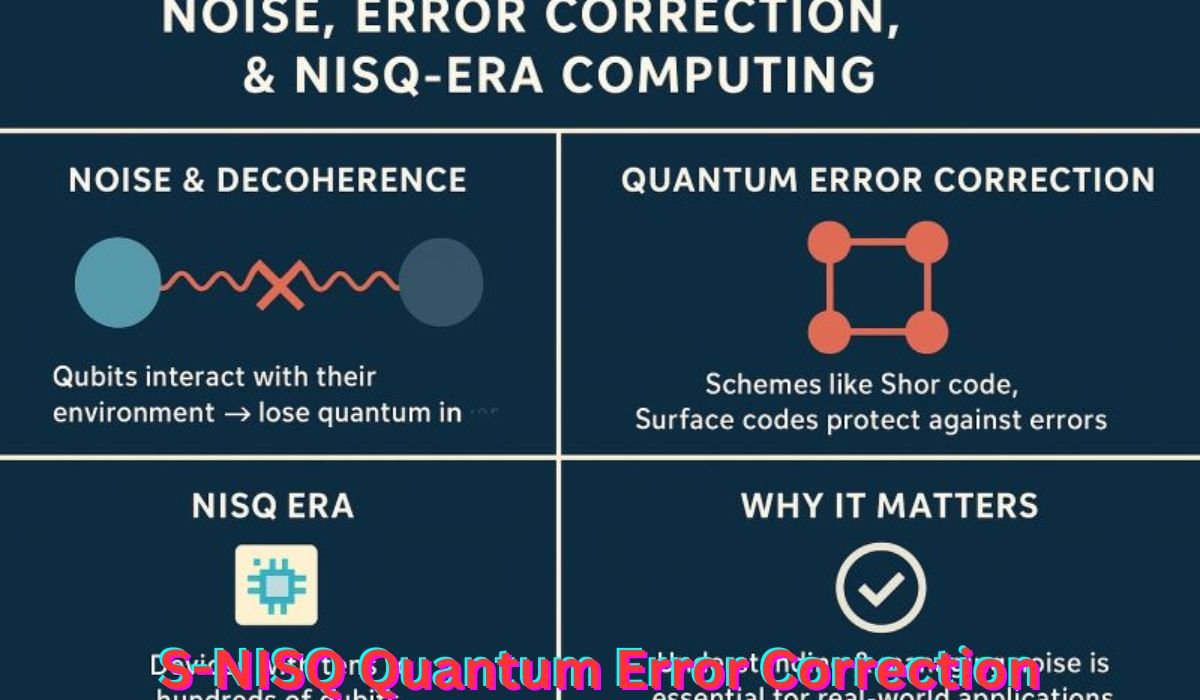
Quantum computing is one of the most exciting frontiers in modern science. It promises to solve problems that classical computing simply cannot handle from drug discovery to climate modeling. But today’s machines are far from perfect, and that gap between promise and reality is exactly where researchers are focusing their energy right now.
That’s the story behind S-NISQ quantum error correction. Designed specifically for the Noisy Intermediate-Scale Quantum (NISQ) era, this framework is a pragmatic, scalable approach to handling the errors that plague today’s quantum processors. It doesn’t wait for perfect hardware, it works with what we have, intelligently and efficiently.
The Challenge of Noise in Quantum Systems

Noise in quantum systems is not just a minor technical hiccup, it is one of the most serious barriers to useful quantum computation. Qubits, unlike classical bits, are extraordinarily sensitive to their surroundings. Even the smallest disturbance can destroy the quantum states that power an algorithm, making the output completely unreliable.
The most common error types researchers deal with include decoherence, gate errors, measurement errors, and cross-talk between neighboring qubits on a chip.
- Decoherence happens when quantum states interact with the environment through thermal fluctuations or electromagnetic interference, causing qubits to lose their delicate coherence over time.
- Gate errors arise from imperfect control pulses during quantum gate operations, introducing inaccuracies that build up across a circuit.
- Measurement errors occur because reading a qubit’s state is not always perfectly accurate, thanks to hardware limitations.
- Cross-talk is when an operation on one qubit unintentionally disturbs a neighboring qubit, corrupting results without any obvious warning.
| Error Type | Primary Cause | Impact on Computation |
| Decoherence | Thermal and electromagnetic interference | Loss of quantum state coherence |
| Gate Errors | Imperfect control hardware | Accumulated inaccuracies in circuits |
| Measurement Errors | Hardware limitations in readout | Incorrect output readings |
| Cross-Talk | Dense qubit proximity | Unintended interference between qubits |
These challenges make it incredibly difficult to run reliable quantum algorithms without some form of error management in place.
Understanding the Concept of S-NISQ Quantum Error Correction

S-NISQ quantum error correction is built around a deceptively simple idea: make error management match the actual capabilities of today’s quantum hardware, rather than demanding resources that don’t yet exist. The “S” stands for scalable and scalability is at the heart of everything this framework does.
Rather than demanding thousands of physical qubits to protect a single logical qubit, this approach uses structured, hardware-aware strategies that extract meaningful reliability from modest resources.
- Scalable error structures that grow gradually alongside hardware improvements
- Hardware-aware techniques tailored to specific quantum architectures
- Hybrid classical–quantum processing that puts powerful classical algorithms to work alongside quantum circuits
- Low-overhead error suppression through smart encoding and circuit design
| Feature | Traditional Approach | S-NISQ Approach |
| Qubit overhead | Thousands per logical qubit | Minimal, scalable overhead |
| Hardware compatibility | Requires near-perfect gates | Works with imperfect NISQ devices |
| Error handling | Full correction | Structured suppression and mitigation |
| Classical role | Limited | Deep integration |
This framework treats quantum reliability not as an all-or-nothing goal but as a spectrum that can be steadily improved over time.
Why Conventional Quantum Error Correction Is Difficult
Traditional error correction codes like the surface code and Shor code are mathematically elegant but practically demanding. They require enormous numbers of physical qubits to protect even a single logical qubit, making them completely out of reach for today’s machines.
The core reasons conventional approaches struggle on current quantum processors include the following challenges.
- Hardware limitations Most NISQ devices simply don’t have enough qubits to allocate thousands toward error correction alone.
- Gate fidelity requirements Standard codes assume extremely high gate fidelity, but many current devices fall short of that threshold.
- Complex circuit depth Error correction circuits involve repeated measurements and complicated entangling operations, adding more opportunities for noise exposure.
- Real-time feedback complexity Continuously detecting and correcting error syndromes requires fast, tightly integrated classical algorithms working alongside quantum hardware in real time.
These obstacles don’t mean quantum error correction is impossible, they mean the strategy has to be smarter and more realistic for where the technology currently stands.
Core Principles Behind S-NISQ Quantum Error Correction
The power of S-NISQ quantum error correction comes from combining several complementary strategies that each address different aspects of the noise problem. Together, they make it possible to achieve meaningful quantum reliability without excessive resource demands.
Structured Error Suppression Rather than correcting every conceivable error, structured error suppression focuses on the most common and impactful error channels on a given device. This keeps correction protocols lightweight while still delivering real improvements.
- Phase errors in superconducting qubits
- Motional errors in trapped-ion systems
- Photon loss in photonic quantum systems
Adaptive Encoding Adaptive encoding means quantum information is stored dynamically, not rigidly. This includes flexible code selection for different tasks, dynamic redundancy that increases only at error-sensitive stages, and task-specific optimization that matches the algorithm’s tolerance for specific error types.
Error Mitigation Techniques Sometimes the goal isn’t to eliminate errors entirely but to correct for them statistically after the fact. Key approaches include zero-noise extrapolation, which estimates error-free results by amplifying noise artificially, probabilistic error cancellation using known error models, and measurement calibration to improve readout accuracy.
| Principle | Method | Benefit |
| Structured Suppression | Target most likely errors | Lightweight, focused protection |
| Adaptive Encoding | Flexible, task-specific codes | Efficient use of limited qubits |
| Error Mitigation | Post-processing corrections | No extra quantum hardware needed |
The Role of Classical Processing
One of the defining features of S-NISQ quantum error correction is how heavily it leans on classical processing. Quantum computers almost never operate alone; classical algorithms perform analysis, optimization, and real-time error management that quantum hardware cannot do for itself.
In this framework, classical processing takes on several crucial roles.
- Real-time error analysis through continuous monitoring of error syndromes and pattern detection across circuits
- Machine learning models, especially neural networks, that learn the noise behavior of specific devices and recommend optimal correction strategies
- Adaptive circuit compilation that restructures quantum algorithms before execution to minimize noise exposure
- Post-processing corrections using statistical methods to refine outputs from noisy circuits
This tight integration between classical computing and quantum execution is what makes hybrid classical–quantum processing so powerful in the NISQ era. The classical side brings intelligence and adaptability that raw quantum hardware lacks.
Architectures Supporting S-NISQ Quantum Error Correction
Different quantum hardware platforms each bring unique advantages and challenges to error correction. The best strategies are always tailored to the specific quantum architecture in use, because no two platforms behave exactly alike.
- Superconducting qubits Fast gate speeds and programmable layouts make these devices ideal for rapid testing of error mitigation protocols. Most leading research labs and companies use them today.
- Trapped-ion systems These offer exceptional gate fidelity and long coherence times, making them excellent candidates for structured correction experiments.
- Photonic quantum systems Naturally resistant to some forms of decoherence, but photon loss remains a significant challenge requiring specialized suppression strategies.
- Neutral atom arrays in optical lattices These allow large quantum processors with flexible connectivity, making them well suited for scalable implementations of error correction frameworks.
| Platform | Key Strength | Main Challenge |
| Superconducting Qubits | Fast gates, programmable | Short coherence times |
| Trapped-Ion Systems | High gate fidelity | Slower gate speeds |
| Photonic Systems | Decoherence resistance | Photon loss |
| Neutral Atom Arrays | Large, flexible arrays | Control complexity |
Each of these platforms benefits from customized implementations of S-NISQ quantum error correction strategies.
Algorithm Design for Error-Resilient Quantum Computing
Beyond hardware-level fixes, error-resilient quantum computing also depends on how algorithms themselves are designed. Smart algorithm design can dramatically reduce the burden placed on error correction systems by limiting noise exposure from the start.
Researchers use several important strategies to make quantum algorithms more robust.
- Shallow circuit design reduces circuit depth, which directly lowers the total exposure to decoherence over the course of a computation.
- Error-aware gate scheduling carefully orders operations to minimize cross-talk and prevent errors from accumulating in sensitive parts of a circuit.
- Symmetry verification exploits the fact that many algorithms preserve known physical symmetries; any deviation from those symmetries signals an error that can be identified and corrected.
- Redundant computation involves running multiple variations of the same circuit to identify consistent results and filter out noise-driven outliers.
When these algorithmic strategies are combined with S-NISQ quantum error correction, even today’s imperfect quantum processors can produce meaningfully reliable outputs.
Applications Benefiting from Improved Error Management
As quantum reliability improves, a growing number of real-world applications become genuinely feasible on quantum hardware. Better error management directly translates into deeper, more accurate computations across several important fields.
- Quantum chemistry Simulating molecular interactions requires precise quantum states maintained across long circuits. Better error correction enables deeper chemical modeling that goes far beyond what classical chemistry software can achieve.
- Optimization problems Algorithms like QAOA (Quantum Approximate Optimization Algorithm) depend on stable, repeatable parameter tuning. Reduced noise leads to more reliable optimization outcomes for logistics, finance, and supply chain problems.
- Material science Studying complex materials involves entangled quantum states that are highly sensitive to noise. Stronger error suppression opens doors to discovering new materials with extraordinary properties.
- Cryptography research Exploring post-quantum security models and developing new cryptographic standards relies on accurate quantum experiments that demand clean, reliable outputs.
Each of these fields stands to gain enormously as S-NISQ quantum error correction continues to mature.
Experimental Progress and Research Momentum
The research community has made genuine, measurable progress in recent years. Labs around the world are publishing results that validate the effectiveness of S-NISQ quantum error correction principles in real experimental settings.
Key breakthroughs and trends include the following developments.
- Logical qubit demonstrations Small-scale logical qubits have been successfully created using modest numbers of physical qubits combined with smart error mitigation strategies, proving the concept works in practice.
- Noise-adaptive circuits Experiments show that circuits dynamically adjusted based on real-time noise behavior achieve significantly higher success rates than static designs.
- Machine learning decoders Advanced decoding algorithms powered by artificial intelligence are proving more effective at interpreting error syndromes than traditional rule-based methods.
- Hybrid error correction models Combining partial fault tolerance with mitigation techniques is delivering substantial reliability improvements on current hardware.
These results suggest that scalable quantum computing may rely heavily on the approaches being pioneered within the S-NISQ framework.
Challenges That Still Remain
Despite the genuine progress, significant challenges remain on the road to fully reliable quantum computation. Honest acknowledgment of these obstacles is part of what makes this research community credible and trustworthy.
- Hardware instability Quantum devices still experience unpredictable fluctuations in noise behavior, making it difficult to design correction strategies that remain effective over time.
- Scalability questions Methods that work beautifully on small experimental quantum systems must remain effective as quantum device scalability is pushed further, which is far from guaranteed.
- Real-time control complexity Integrating fast classical processing with live quantum hardware requires sophisticated control electronics and extremely tight timing, which is technically demanding to engineer reliably.
- Error modeling accuracy Incomplete error modeling of noise processes can cause mitigation strategies to miss important error channels, limiting overall effectiveness.
Overcoming these barriers will require collaboration across hardware engineering, theoretical physics, software development, and machine learning research.
Future Outlook for S-NISQ Quantum Error Correction
The future of S-NISQ quantum error correction looks genuinely promising. As quantum fabrication techniques improve and control electronics become more sophisticated, the strategies developed in the NISQ era will become even more powerful.
Several major trends are expected to shape the next phase of development.
- Integration with fault-tolerant architectures Hybrid systems will likely combine NISQ-era methods with emerging large-scale error correction codes, creating a bridge between today and fully fault-tolerant quantum computers.
- AI-driven noise optimization Artificial intelligence will increasingly analyze hardware behavior in real time and dynamically adjust error suppression strategies on the fly, far faster than any human team could manage.
- Modular quantum systems Networked quantum processors distributed across modular quantum systems could share error correction tasks, reducing the burden on any single device.
- Improved logical qubit stability Gradual advances in hardware and software together could eventually produce logical qubits stable enough to sustain the long computations required by large-scale quantum algorithms.
The convergence of these trends could transform quantum computing from a laboratory curiosity into a genuinely powerful practical tool.
Read Also This: Lobotomy Piercing: Body Modifications A Deep Dive
The Path Toward Reliable Quantum Computation

Building truly reliable quantum computation is one of the great technological ambitions of this century. It requires not just better quantum hardware, but smarter, more adaptive strategies for managing the inevitable noise that comes with pushing physics to its limits. S-NISQ quantum error correction represents exactly that kind of smart, adaptive thinking grounded in the reality of today while reaching toward the possibilities of tomorrow.
The journey is still unfolding, and many hard problems remain. But the frameworks, experiments, and insights emerging from S-NISQ quantum error correction research are steadily laying the foundation for a future where quantum advantage is not just a theoretical promise but an everyday computational reality one careful, error-corrected qubit at a time.
Frequently Asked Questions
How do quantum computers fix noisy errors?
Quantum systems are very sensitive to noise and heat. S-NISQ Quantum Error Correction helps reduce mistakes during complex quantum computing tasks.
Why do scientists need better quantum stability?
Quantum bits can lose information very quickly today. S-NISQ Quantum Error Correction improves stability and keeps calculations more accurate over time.
Can noisy quantum machines become more reliable?
Modern quantum devices still face many hardware problems. S-NISQ Quantum Error Correction supports reliable performance without requiring perfect quantum hardware.
What makes quantum computing more accurate now?
Error rates affect the speed and quality of results. S-NISQ Quantum Error Correction lowers faults and improves quantum processing efficiency.
How does quantum error handling actually work?
Quantum systems use special methods to detect tiny faults. S-NISQ Quantum Error Correction protects qubits from losing valuable computational information.
Why is quantum correction important for the future?
Future AI and research depend on stable quantum systems. S-NISQ Quantum Error Correction helps create safer and stronger next-generation computing technologies.
Can quantum computers work better with fewer failures?
Small quantum errors can ruin long scientific calculations. S-NISQ Quantum Error Correction reduces failures and supports more dependable quantum experiments.


